Contents
- Why volume is the wrong first sort
- The Portuguese people actually type
- Reading a marketplace-owned SERP
- Building the intent map
- What the AI module adds
- Neighbourhood-level intent in São Paulo
- Seasonality a Brazilian plan must respect
- Queries answered before the click
- From map to brief
- Frequently asked questions
Why volume is the wrong first sort
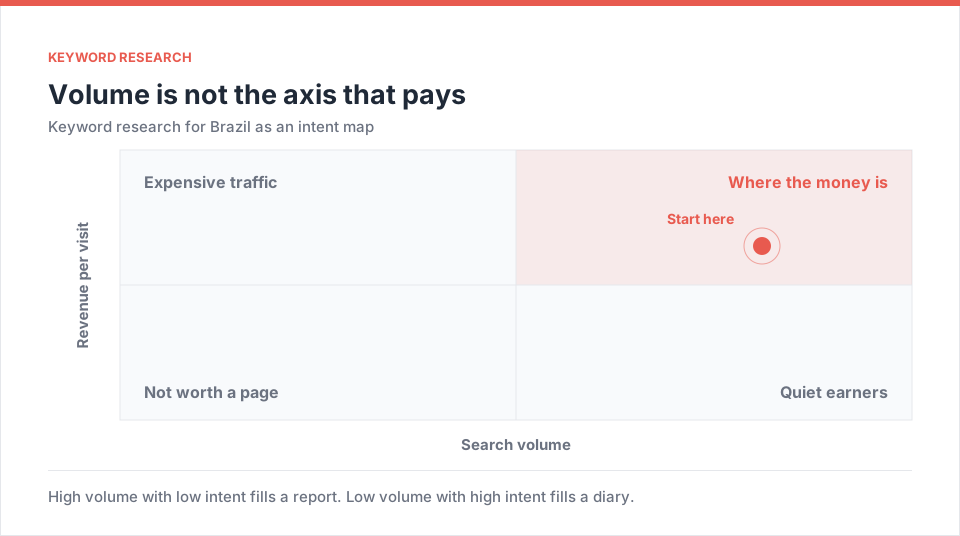
Search volume answers one question: how many people typed this. It says nothing about whether they wanted to buy, whether Google will show a site like yours, or whether the click is worth anything. In Brazil the disconnect is sharper than in most markets, because the highest-volume commercial queries resolve into SERPs where the organic results are marketplaces and the top of the page is sponsored. Ranking fifth for a term like that is a rosette, not revenue.
So the first sort is never volume. It is: can a site like mine appear here at all, and does the person typing this want what I sell? Everything else is downstream of those two questions.
The Portuguese people actually type
Keyword tools normalise. Real Brazilian search does not. Four habits change the shape of a keyword list:
- Accents get dropped. People type «preco», «servico», «manutencao» on phone keyboards. Google reconciles these, but your on-page copy and internal anchors should read naturally, not chase the unaccented spelling.
- Questions come in spoken form. «quanto custa», «vale a pena», «como funciona», «qual o melhor» — these are complete queries, and they map to different pages than the noun on its own.
- Regionalism is real. Terms shift between the South, the Northeast and São Paulo. If you sell nationally, decide deliberately whether to write one page in neutral Brazilian Portuguese or several regional pages — do not let the variation happen by accident across a blog.
- Portugal is not your market. European Portuguese vocabulary in your copy reads as imported and converts badly. If you serve both, that is an hreflang decision (
pt-BRandpt-PT), not a stylistic one.
Reading a marketplace-owned SERP
Before writing anything, look at the live result page for the query on mobile — the same reading exercise described in the audit walkthrough when judging whether a page can rank at all. Three outcomes, three different decisions:
| What the SERP looks like | What it means | What to do |
|---|---|---|
| Marketplace listings top to bottom | Google reads the query as «buy a product» | Skip for content; win it with a feed or paid |
| Mixed: one marketplace, blogs, a video | Intent is still forming | Winnable with a genuinely better page |
| Guides, forums, an AI Overview | Informational, decision not made | Own it — this is where content wins |
Semalt shows this as a SERP-composition column next to each keyword, so the judgement can be made across a thousand terms instead of one at a time. The output of this pass is usually brutal: a large share of the imported list gets marked «not winnable with content» and leaves the plan. That is the pass doing its job.
Building the intent map
What survives gets grouped by what the person wants, not by shared words:
- Problem-aware — they know the symptom, not the solution. «por que meu site nao aparece no google». Long content, no pricing, one soft call to action.
- Solution-aware — comparing approaches. «consultoria seo ou agencia». Comparison tables, honest trade-offs, case evidence.
- Vendor-aware — choosing whom to hire. «agencia de seo em sao paulo». Proof, prices or price ranges, a form that a person actually answers.
- Ready — brand and transactional terms. Protect these; never let a blog post cannibalise the page that closes the deal.
One page per intent. The commonest structural mistake we inherit is an agency page trying to serve all four at once: it explains the problem, compares approaches, sells the service and lists prices in 3,000 words, and consequently ranks well for none of them.
What the AI module adds
The value is not that it produces more keywords — anyone can produce more keywords. Three outputs are worth the seat:
- Clustering by meaning, not string match. «quanto custa seo» and «valor de consultoria de seo» belong to the same page even though they share almost no characters.
- The questions under the query. Pulled from People Also Ask, forum threads and the phrasing AI assistants use when they cite sources — which is increasingly where the answer gets rendered before anyone clicks.
- Estimated commercial value. A blend of intent, SERP composition and observed conversion in comparable accounts, so a 90-a-month query with buying intent can outrank a 12,000-a-month browsing query in the plan.
Treat every AI output as a draft judgement. The module is right often enough to save days and wrong often enough that you must open the SERP yourself for anything you plan to spend a month building.
Neighbourhood-level intent in São Paulo
«in São Paulo» is not a location, it is twelve markets. Someone searching from Pinheiros, Santo André and Guarulhos has different expectations about price, travel and even response time. Where the service is genuinely local — a clinic, a workshop, a studio — the winnable queries carry the district: bairro plus service, station plus service, «perto de mim» on mobile.
Two rules keep this from turning into doorway pages. First, a district page needs district-specific substance: the actual address, real travel times, photographs, staff, cases from that area. Second, if you cannot write that substance, do not create the page — strengthen the main service page and the Google Business profile instead, which is where those searches resolve anyway.
From map to brief
Each cluster leaves the process as a brief carrying: the primary query, the secondary ones the same page should absorb, the four to six questions the page must answer outright, the internal links in and out, and the honest reason someone would choose this page over the result currently ranking. If that last line cannot be written, the cluster is not ready.
The test we apply before commissioning
Read the brief and ask: if this page ranks first, does anything happen? A visit with no plausible next step is a cost. Plenty of high-volume clusters fail this test and should never be written.
Seasonality a Brazilian plan has to respect
Demand in Brazil is not evenly spread across the year, and a content calendar that ignores this publishes its best page six weeks too late. Five moments reshape search volume enough to plan around:
- Black Friday and the run-up. Comparison and «vale a pena» queries start climbing in early October. A page published in the second week of November is competing with pages Google has already been evaluating for a month.
- Volta às aulas. January and, in a smaller second wave, July. Relevant far beyond stationery — transport, uniforms, insurance, clinics and tutoring all move.
- Dia das Mães and Dia dos Pais. Gifting intent concentrates into roughly three weeks, and the winning pages are the ones already ranking when the window opens.
- Carnaval. B2B demand does not pause so much as displace; deadlines shift and the following fortnight carries the backlog. Plan publication around it rather than through it.
- 13º salário. December income visibly lifts considered purchases — appliances, dentistry, renovation, travel. Queries acquire a price-comparison tone in the same period.
The operational rule is simple: a seasonal page goes live at least eight weeks before the peak, gets its internal links immediately, and is refreshed rather than replaced the following year so it keeps whatever authority it earned.
Queries that get answered before the click
A growing share of informational searches now resolve inside an AI Overview or an assistant's answer. That does not make the query worthless — it changes what winning looks like. Three practical adjustments:
- Answer in the first hundred words. A direct, self-contained answer near the top is what gets quoted. Burying it under context loses the citation and the reader.
- Make the facts checkable. Named prices, dates, ranges and conditions travel into generated answers far better than adjectives, and they give a reason to click through for the detail.
- Split informational from commercial. If a page tries to both answer and sell, it is usually too diluted to be cited and too vague to convert. Separate them and link.
Track these clusters differently, too: impressions with a falling click-through rate on a question query often mean you are being read without being visited, which is a brand outcome rather than a traffic one and should be reported as such.
Frequently asked questions
How many keywords should a page target?
One intent, which usually means one primary query and a handful of phrasings of the same want. Counting keywords is the wrong unit — counting intents is the right one.
Should I write for unaccented spellings?
No. Google reconciles them. Write correct Portuguese and let the search engine do its job.
What about queries dominated by marketplaces?
Concede them for content, and compete there through the product feed, marketplace listings themselves, or paid. Spending three months writing a guide for a SERP with no organic slot is the most expensive mistake in Brazilian ecommerce SEO.
How long before a new cluster proves itself?
Give it 90 days before judging, and check striking distance at day 30 — movement from position 20 to position 9 is progress even though traffic has not moved yet.
Where does this connect to the rest of the platform?
Positions and revenue land in Analytics; the gaps your rivals already cover come from competitor analysis.
In a market where the biggest SERPs are already spoken for, keyword research is mostly an exercise in deciding what not to write. Sort by winnability and intent; treat volume as the last column, not the first.
Practical next step
Take your five highest-volume target terms, open each on a phone, and mark which ones have an organic slot a site like yours could occupy. That single hour usually rewrites the quarter's plan.
Open Semalt Keyword Research →