Contents
- Picking the right five domains
- The gap report, read properly
- Backlinks: what is reproducible
- Reading their structure, not their content
- What to copy and what to leave
- What their ad spend reveals
- Worked example: clinics in Moema
- Four ways this goes wrong
- Setting up the watch
- Frequently asked questions
Picking the right five domains
Ask any Brazilian client who their competitors are and you will get the sales answer: three companies of similar size in the same city. Then look at the SERP and find Mercado Livre, a comparison portal, a marketplace seller's storefront and a five-year-old blog post from a site that left the industry.
Keep both lists, separately. The commercial rivals tell you about positioning, pricing and proof — useful for what your pages must say. The SERP rivals tell you what Google currently rewards for these queries — useful for what your pages must be. Confusing the two produces the classic failure: a beautifully written service page competing for a query where Google only shows product listings.
Five tracked domains is plenty: two commercial, two SERP incumbents, one site that has grown fast recently. That last slot matters most, because a site rising quickly is running a strategy you can still observe in motion.
The gap report, read properly
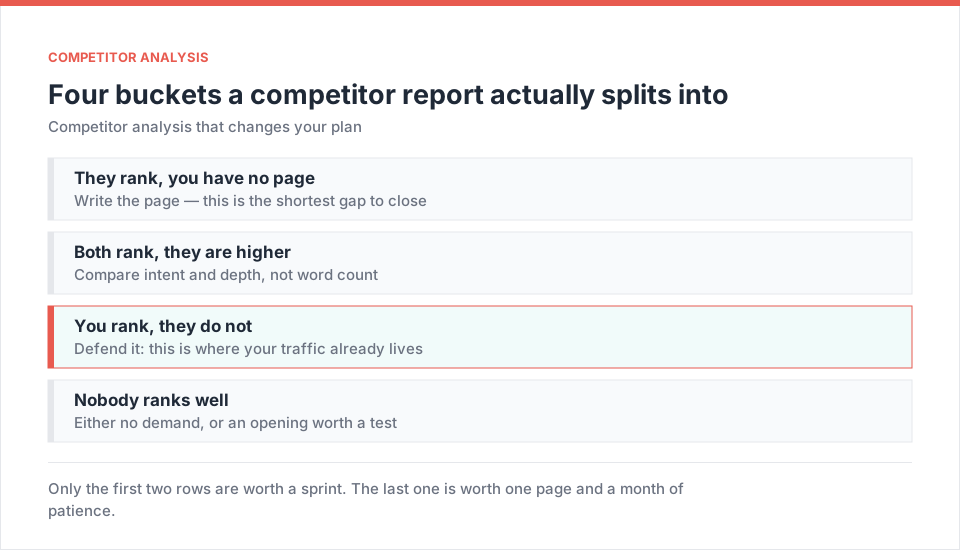
The gap view lists queries where they rank and you do not. Read it in three passes rather than exporting it wholesale:
- Discard what you cannot serve. Terms about products you do not sell or regions you do not serve are noise, however large the number next to them.
- Separate the winnable from the owned. A query where the incumbent is a marketplace is not a gap; it is a wall. A query where the incumbent is a thin 2019 blog post is an open door.
- Sort what remains by proximity. Terms where you already rank 11–25 and they rank in the top five are the cheapest wins on the entire list, because the page exists and only needs work.
What usually survives all three passes is a short list — often fewer than twenty queries. That is the correct outcome. A gap report that leaves you with 900 opportunities has not been read.
Backlinks: what is reproducible
Half of any Brazilian competitor's link profile is not available to you at any price: coverage from a company acquisition, a founder's newspaper column, links from a parent group. Ignore those. Three categories are reproducible and worth the export:
- Trade and association listings. Sector bodies, chambers, professional registries. Slow, dull, durable.
- Regional press with a real reason. A genuine local story earns a genuine local link; a press release does not.
- Resource pages and partner directories. If a rival is listed as a supplier or partner somewhere, that page will usually list you too, given a reason.
Look at the timeline as well as the list. Links acquired steadily over years describe a business doing normal things; two hundred links in one month describe a campaign, and often one you would not want to imitate.
Reading their structure, not their content
The most transferable intelligence is architectural. Crawl the rival and look at how the site is organised rather than what it says:
| What you see | What it tells you |
|---|---|
| One page per service × district | They are competing on local intent and can staff it |
| A deep FAQ under every service | They are chasing question queries and assistant citations |
| Catalogue pages generated per model or part | They are winning the specific queries marketplaces ignore |
| A blog updated twice a year | Content is not where they are investing — an opening |
| Prices published openly | They are filtering leads before the form, not after |
What to copy and what to leave
Copy structure, formats and coverage: the fact that they answer installation questions on the product page, the fact that they publish a price range, the fact that every service page carries a case from that neighbourhood. Do not copy their text, their angle or their claims — and in a network of sibling city sites, do not copy their pages with the city name swapped either. That produces two pages competing to say the same thing worse, and a reader who can tell.
The one structural change per cycle rule keeps this honest: implement it, wait, measure, then take the next one. Rebuilding a site to look like a competitor in one quarter leaves you unable to say which change did anything.
Their paid footprint tells you what converts
A rival's ad spend is the most honest research document they publish. Nobody keeps paying for a keyword that does not convert, so the terms they have bid on continuously for six months are terms that make money in your category — information no volume estimate can give you.
- Persistent terms — running month after month. Treat these as validated commercial intent and prioritise the organic equivalent.
- Seasonal bursts — appearing for six weeks a year. Useful for calendar planning; they tell you when the category's money moves.
- Brand defence — bidding on their own name, or on yours. The second one is a compliment and a signal that your brand demand is worth intercepting.
- Landing pages behind the ads — usually their best converting layout, refined against real spend. Study the structure: what is above the fold, where the form sits, what proof appears before the price.
A worked example: three clinics in Moema
A dental clinic asked us why a competitor two streets away outranked them for everything. The gap report showed the rival ahead on 60-odd queries, which looked hopeless until it was read in three passes.
Half those queries were procedures the client does not offer — discarded. Around a dozen were dominated by health marketplaces and aggregator directories, where no independent clinic held an organic slot — conceded, and moved to the paid and profile plan instead. What remained was fourteen queries, all of them procedure-plus-neighbourhood, where the rival ranked third to fifth with pages that were thin but specific: a paragraph on the procedure, a price range, a photograph of the actual room and a same-day contact block.
The advantage was not authority, budget or backlinks. It was that fourteen pages existed at all, each answering one question completely, while the client had a single «treatments» page listing everything.
The plan that came out of the analysis was correspondingly boring: fourteen pages, one per procedure, each with the price range published, real photographs and a booking block — plus the Google Business profile brought into line with the same information. No links were bought and nothing was rebuilt.
Four ways this analysis goes wrong
- Tracking too many domains. Fifty competitors in a dashboard produce weekly noise and no decisions.
- Reacting to weekly position wobble. Positions oscillate. Judge on a 30-day window and on structural change.
- Copying a rival who is also losing. Check that the site you are imitating is actually growing before you rebuild anything to look like it.
- Mistaking a marketplace for a competitor. You are not going to out-rank Mercado Livre on a product query. Compete where an independent site can appear at all.
Setting up the watch
Continuous monitoring beats quarterly reports, but only for a few specific events. The alerts worth having are: a rival appearing for a query in your core set, a rival's page being substantially rewritten, and a sudden change in their indexed page count — the last one is how you spot a programmatic push in its first week rather than its sixth month.
The question to ask of every finding
Would we do this if they were not doing it? If the answer is no, it belongs in the notes, not the roadmap. Competitor analysis that only produces imitation is how a market ends up with six identical websites.
Frequently asked questions
Can they see that I am analysing them?
No. Everything here comes from public search results, public pages and third-party link indexes.
How many competitors should I track?
Five, reviewed every quarter. Tracking more produces a dashboard nobody reads and no decisions.
What if the top results are all marketplaces?
Then the content opportunity is elsewhere: the specific, the local, the technical, and the questions asked before the purchase. See the keyword research guide for how to find those systematically.
How often does the picture change?
Positions move weekly and mean little; structure moves quarterly and means a lot. Judge on a 30-day window at minimum.
Where does this connect to the rest of the platform?
Confirmed gaps become briefs; delivery is measured in Analytics, and blockers usually surface in the technical audit.
Separate the domain that outranks you from the company that beats you, discard what is not winnable, and copy structure rather than sentences. The useful output is a short list, not a dashboard.
Practical next step
Take your ten most valuable queries, note who holds the top three organic slots for each, and mark whether that holder is a marketplace, a rival, or a page nobody has touched in years. The plan writes itself from that table.
Open competitor analysis →