Contents
What AutoSEO actually does
Strip the marketing and the product is a loop: crawl, detect, apply, verify, repeat. The work it takes off a team's hands is real and unglamorous.
- Titles and meta descriptions at scale. Rewritten against the queries the page actually earns, kept inside the length that survives truncation, with the brand where it belongs.
- Internal links. New content linked from the pages that already have authority, and orphan pages surfaced and connected — the single most under-used lever on most catalogues.
- Structured data upkeep. Markup kept consistent with what the page shows as products, prices and dates change.
- Indexing hygiene. New URLs submitted promptly, broken internal links caught the day they appear, redirect chains flattened.
- Image and heading housekeeping. Alt text, dimensions, heading order — the checklist items that decay silently as a site grows.
On a catalogue with thousands of URLs, this is weeks of recurring manual work per quarter. That is the honest case for automation: not magic, just the removal of a repetitive tax.
Where automation stops
Four things it cannot do, and pretending otherwise is how disappointment starts:
- Decide what to write. Choosing which market to attack is judgement about your business, not a pattern in a crawl.
- Earn a link. Links come from doing something worth mentioning. No tool arranges that.
- Fix architecture. If your catalogue generates near-identical URLs from filters, that is a platform decision requiring a developer and a plan.
- Write with a point of view. Generated copy is competent and interchangeable; the pages that win competitive Brazilian SERPs are the ones with a specific answer nobody else published.
Which sites it fits
| Situation | Verdict | Why |
|---|---|---|
| Catalogue with thousands of SKUs, small team | Strong fit | The recurring work scales past what humans can maintain |
| Content site publishing weekly | Good fit | Linking and indexing upkeep is most of the maintenance burden |
| Ten-page brochure site | Poor fit | An afternoon of manual work replaces a subscription |
| Site with no organic strategy yet | Wrong order | Decide what you are competing for first |
| Site in a marketplace-dominated niche | Depends | Automation cannot create an organic slot that does not exist |
When FullSEO is the right answer
FullSEO adds the human layer: strategy, editorial direction, link acquisition, and someone accountable for the outcome rather than the checklist. It is the right choice when the bottleneck is judgement rather than throughput — a competitive market, a migration, a category where the difference between winning and losing is what the page says rather than how tidy its markup is.
The practical way to decide is to look at last quarter honestly. If your SEO work stalled because nobody had time to apply known fixes, buy throughput. If it stalled because nobody knew which fight to pick, buy judgement. Buying the wrong one is how a year gets spent producing immaculate metadata for pages that were never going to rank.
The arithmetic to run first
Before any subscription, work out three numbers for your own site:
- The value of a position gain. Take one commercial query, estimate the clicks a move from position 8 to 3 would add, apply your conversion rate and average order value in BRL. That is the ceiling of what the change is worth per month.
- The cost of the manual alternative. Hours per month your team currently spends on the tasks listed above, at their real cost.
- The time to effect. Assume 90 days before the result is legible, longer in a competitive category. Budget for that period, not for the first month.
If number one is smaller than the annual cost of the plan, the answer is no, regardless of how good the product is. Publishing that arithmetic honestly is also, incidentally, the kind of page that ranks — Brazilian buyers search «vale a pena» before they search a brand.
Guardrails to set before you switch it on
Automation applied to a site nobody has agreed rules for is how a brand ends up with 4,000 identical meta descriptions. Five settings are worth arguing about before the first cycle runs:
- Which templates are in scope. Product and category pages, yes. Legal pages, the homepage and any hand-crafted landing page, no — those have owners.
- Brand rules in the title. Decide the format once: where the brand sits, whether the city appears, what gets dropped when the length runs out.
- A word-count floor. Never let automation touch a page that is already thin; fix the content first, or the tool tidies the metadata of a page that should not be indexed.
- Link volume per page. A ceiling on automatically inserted internal links keeps a catalogue readable and prevents footer-style link soup inside body copy.
- A review queue for the first cycle. Read the first two hundred changes before trusting the pattern. After that, sample monthly.
Case: a catalogue with 8,000 SKUs
A distributor in the ABC region had a catalogue nobody had maintained since the platform migration: titles auto-generated from the SKU code, roughly a third of products orphaned from any category page, structured data still advertising prices from two price lists ago.
None of that requires strategy — it requires throughput no small team has. The automated pass rewrote titles against the queries each product actually earned, connected the orphans to their categories, and brought the markup back into line with the live price feed. The interesting result was not the ranking movement; it was that the pages which recovered fastest were the fitment-style long-tail products the team had never prioritised, because those were the only queries where marketplaces were not already occupying every organic slot.
The judgement work — deciding that the catalogue should compete on specific fitment terms rather than on category head terms — still had to be done by people. The tool made that decision cheap to execute across 8,000 URLs.
Questions worth asking any vendor, including this one
- Can every change be reviewed before it goes live, and reverted after?
- What exactly is edited — the database, the template, or an injected layer — and what survives if we cancel?
- Where does the data live, and does the contract cover the LGPD obligations we carry?
- What does the tool explicitly refuse to do? A vendor with no answer has not thought about it.
- What does month three look like if it works, and what does it look like if it does not?
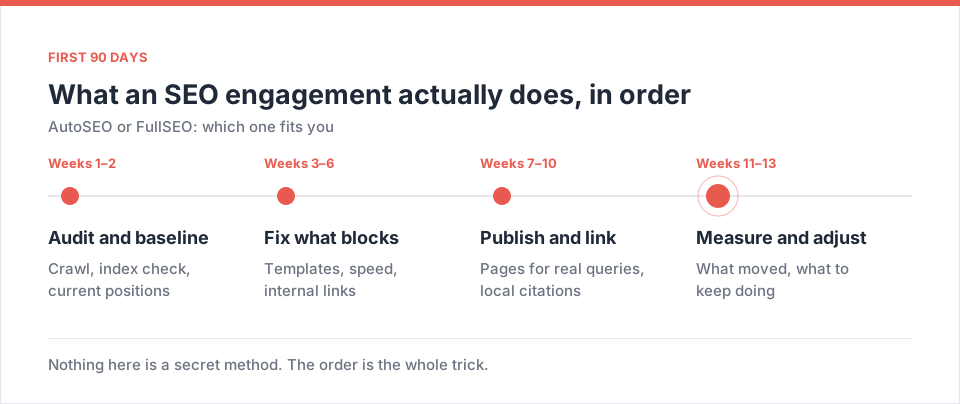
The first 90 days, realistically
Crawl and baseline
Full inventory, current positions recorded, the backlog of routine fixes generated and reviewed before anything is applied.
The unglamorous pass
Titles, descriptions, internal links, orphans, markup. Nothing visible to a visitor; a great deal visible to a crawler.
First movement
Striking-distance terms move first. Expect position changes before traffic changes, and traffic before revenue.
The honest review
Compare against the baseline, not against hope. Decide whether the constraint is now throughput or judgement, and adjust the plan accordingly.
What we tell clients before they sign
Automation compounds an existing strategy and cannot substitute for one. If you cannot name the twenty queries you intend to win, spend the first month on that instead — the tool will still be there, and it will be worth more.
Frequently asked questions
Will it change my pages without asking?
You choose the mode. Review-then-apply is the sensible default for a first cycle; fully automatic makes sense for large catalogues once you trust the pattern.
Can I roll a change back?
Yes — every change is versioned and reversible. Ask this question of any tool that edits your site, not just this one.
Does it replace an agency?
It replaces the repetitive part of an agency's work. It does not replace the person deciding which market you are trying to win.
How quickly does it show results?
Technical corrections are visible within days; ranking movement takes weeks; revenue takes a quarter. Anyone promising faster is describing luck.
What should I read next?
Set priorities with Analytics, clear blockers using the audit walkthrough, and pick your targets with the keyword research guide.
AutoSEO buys throughput; FullSEO buys judgement. Diagnose which one you actually lack, run the arithmetic on a single commercial query, and give it a full quarter before deciding whether it worked.
Practical next step
Estimate what one query moving from position 8 to position 3 is worth to you per month in BRL. If you cannot produce that number, that is the first thing to fix — not your metadata.
Open Semalt AutoSEO →